- Jun 4
5 Questions We Should Be Asking at Every AI Summit
- Lanise
- 0 comments
As I prepare for the Minnesota AI Summit, I've been thinking about the conversations happening across education, business, government, and philanthropy.
Everywhere I go, people are talking about AI tools. Everyone has an opinion a strong one, good or bad.
Fewer people are talking about AI leadership.
And that's a problem.
We are moving so quickly to adopt AI that we often skip the harder questions about purpose, power, and people. We spend hours discussing what the technology can do and very little time discussing what it should do.
I've attended enough technology conferences over the years to know that innovation often arrives long before wisdom.
So before we rush toward the next platform, chatbot, or productivity breakthrough, here are five questions I believe every AI Summit should be asking.
1. What problem are we actually trying to solve?
Not every challenge requires artificial intelligence.
Sometimes what looks like a technology problem is actually a leadership problem, a communication problem, or a systems problem.
When AI becomes the starting point instead of the problem we're trying to solve, we risk investing in solutions that create more complexity than value.
The question isn't "How can we use AI?"
The question is "Why should we?"
2. Who benefits and who bears the risk?
Every innovation creates winners and losers.
History has shown us that new technologies often amplify existing inequities before they address them.
As leaders, we have a responsibility to ask:
Who gains access?
Who gains efficiency?
Who gains opportunity?
And who gets left behind?
If we are not intentionally examining the impact of AI on historically marginalized communities, we are not leading responsibly.
3. What happens to human judgment?
I am concerned that we're beginning to treat AI-generated answers as objective truth.
They aren't.
AI can generate information, summarize patterns, and support decision-making.
It cannot replace wisdom.
It cannot replace context.
And it certainly cannot replace human responsibility. We still have to consider what it can do. In what ways can it improve what humans do?
The more powerful AI becomes, the more important human judgment becomes.
4. Are we designing for efficiency or for human flourishing?
Efficiency is not the highest human value.
Neither is productivity.
If AI helps us work faster but diminishes creativity, relationships, trust, or agency, have we actually made progress?
I believe leaders should be asking a bigger question:
How can AI help people thrive?
That conversation is far more important than saving a few minutes on a task.
5. What kind of future are we building?
Every technology decision is ultimately a values decision.
Whether we acknowledge it or not, the systems we build today are shaping the world our students, employees, and communities will inherit tomorrow.
The future isn't something that happens to us.
It is something we design.
And that design process requires intentionality.
It requires courageous leadership
The Conversation We Need
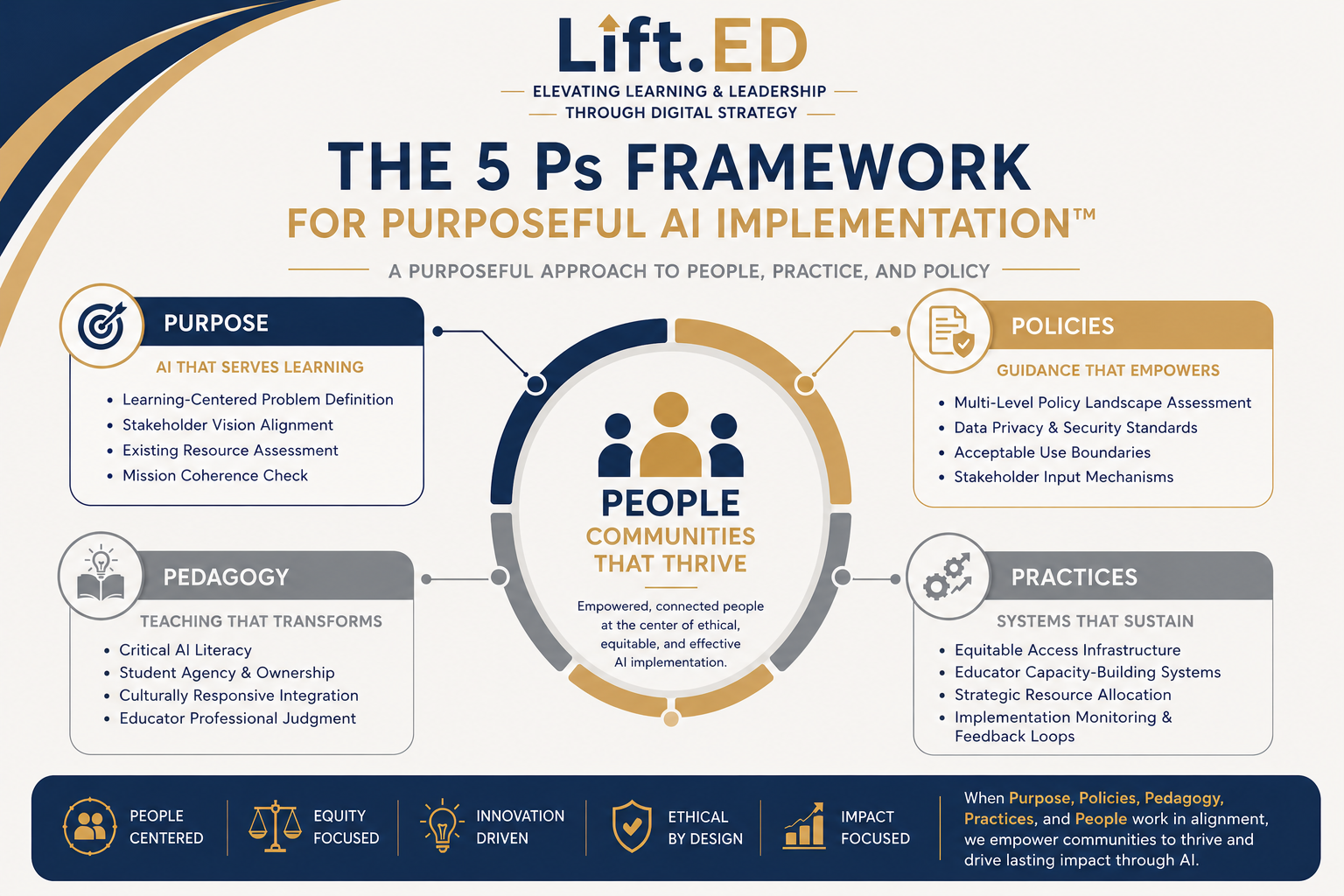
At this year's Minnesota AI Summit, I'll be sharing the 5Ps Framework :Purpose, Policies, Pedagogy, Practices, and People as part of my session, Purposeful by Design: A Liberation Innovation Approach to AI Leadership.
Because I believe the most important AI question isn't:
"What can this technology do?"
It's:
"What kind of leaders do we need to become in order to use it wisely?"
That's the conversation I'm interested in having.
I hope you'll join me.
If this raised questions about your institution's AI strategy, the Justice Juncture Analyzer is a free place to start. Or book a free 30-minute conversation to explore what a justice-centered approach would look like for your team. Schedule Here