- Jun 13
5 Things I'm Learning About AI Leadership While Everyone Else Is Talking About Tools
- Lanise
- 0 comments
There is no shortage of AI conversations right now.
Every conference agenda, webinar, LinkedIn feed, and professional development session seems to focus on the same questions:
What tool should we use?
How can we save time?
What's the next breakthrough?
Those are important questions.
But after spending decades working at the intersection of leadership, technology, and educational transformation, I've learned that the biggest challenges are rarely technical.
They're human.
As I prepare for conversations at the Minnesota AI Summit and beyond, here are five things I'm noticing about AI leadership that deserve more attention.
1. Most AI Challenges Aren't Technology Problems
They're leadership problems.
Organizations often tell me they're struggling with AI implementation. When we dig deeper, the challenge isn't the technology.
The challenge is the absence of a shared vision. Different stakeholders have different goals.
Policies haven't caught up. Roles and responsibilities are unclear.
Trust is fragile. Technology simply exposes what already exists.
AI doesn't create leadership challenges.
It magnifies them.
2. Access Is Not the Same Thing as Equity
For years, education focused on closing the digital divide by providing devices and internet access.
That work mattered. But AI is revealing a new divide.
Having access to a tool does not guarantee meaningful participation.
Students and educators need opportunities to critically understand, question, and shape how technology impacts their lives.
If only some communities have the knowledge, confidence, and influence to direct the future of AI, we haven't achieved equity.
We've simply created a more sophisticated version of the same problem.
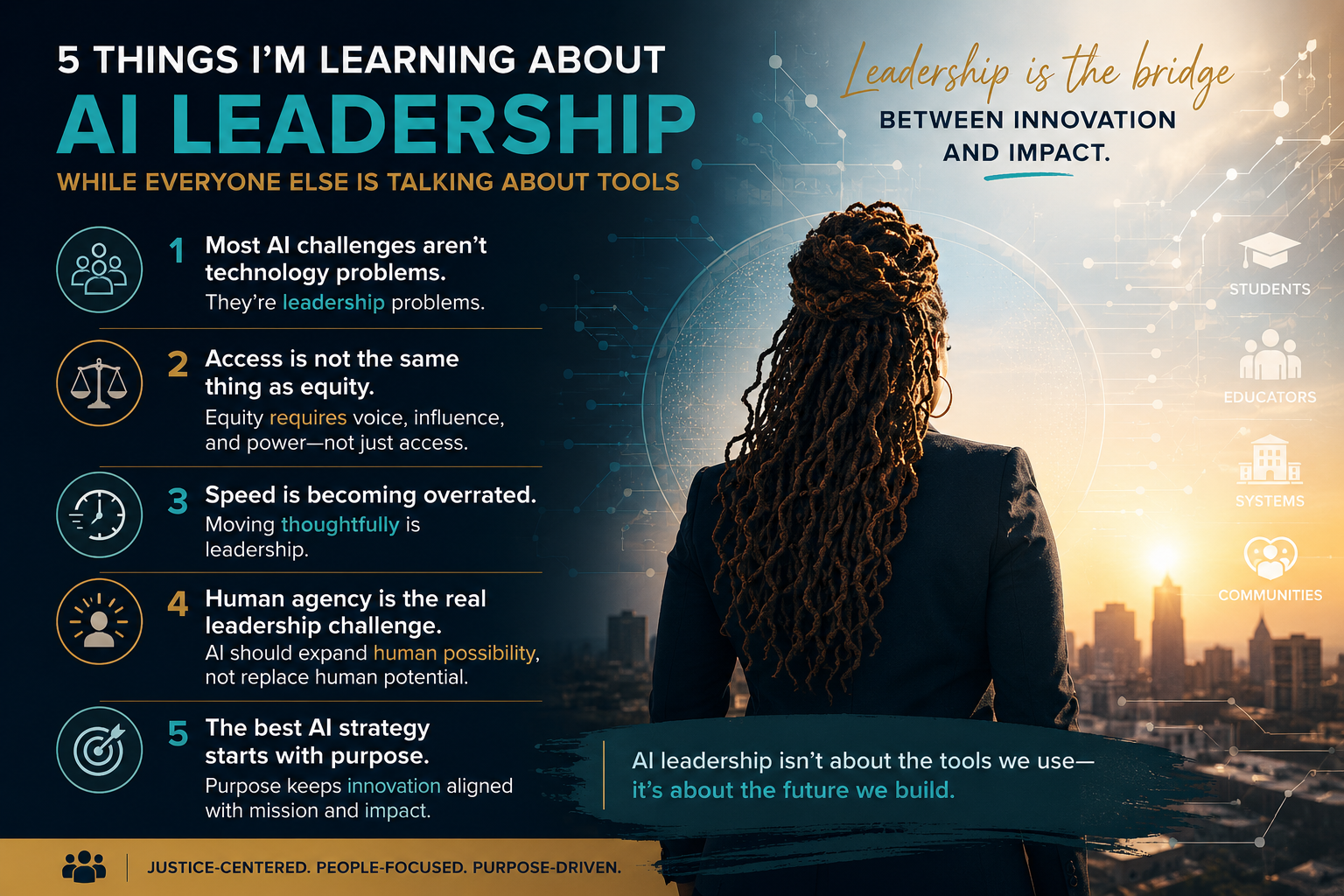
3. Speed Is Becoming Overrated
Many leaders feel pressure to move quickly. I understand why.
Nobody wants to be left behind. But I worry that we're beginning to confuse speed with progress.
Some of the most important AI decisions involve ethics, governance, privacy, instructional impact, workforce implications, and community trust.
Those conversations deserve time. Moving fast feels innovative.
Moving thoughtfully is leadership.
4. Human Agency Is the Real Leadership Challenge
The future isn't about whether AI can think.
The future is about whether people will continue to think.
As AI becomes more capable, leaders must intentionally create cultures where curiosity, critical thinking, creativity, and professional judgment remain essential.
The goal should never be replacing human expertise.
The goal should be expanding human possibility.
Technology should serve people.
People should never become servants of technology.
5. The Best AI Strategy Starts With Purpose
Every AI initiative eventually runs into the same question:
Why are we doing this?
Not because the answer isn't obvious.
Because most organizations never slowed down long enough to define it.
Purpose is what allows leaders to make difficult decisions when competing priorities emerge.
Purpose is what helps distinguish innovation from distraction.
Purpose is what keeps technology aligned with mission.
Without purpose, AI becomes another initiative.
With purpose, it becomes a tool for transformation.
A Final Thought
The leaders I admire most are not the ones chasing every new technology trend.
They are the ones asking better questions.
They understand that AI leadership is not fundamentally about artificial intelligence.
It's about stewardship.
It's about responsibility.
It's about creating systems that help people flourish.
And perhaps most importantly, it's about remembering that every technology decision is ultimately a human decision.
That's the work.
And for those of us leading through this moment, it's the work that matters most.