- Jun 9
What Liberation Innovation Has to Do with AI Leadership in 2026
- Lanise
- 0 comments
The AI conversation is moving fast.
Almost every week, there is a new platform, a new tool, a new breakthrough, or a new prediction about how artificial intelligence will transform education and work.
Yet the question I continue to ask is simple:
What kind of leadership does this moment require?
Because despite all the attention being given to AI tools, many organizations are still making AI decisions without a clear framework for understanding the systems those decisions will impact.
That is where Liberation Innovation comes in.
Liberation Innovation Was Never About Technology
People often assume Liberation Innovation is an innovation framework.
It isn't.
At its core, Liberation Innovation is a way of seeing.
Before leaders can improve a system, they must understand what that system is currently producing, who it benefits, who it burdens, and what assumptions are shaping its outcomes.
Too often, organizations jump directly into solutions.
They implement a new initiative.
They purchase a new platform.
They launch a new strategy.
And then they wonder why meaningful change never happens. Liberation Innovation begins somewhere different.
It starts by helping leaders see.
The LIFE Architecture
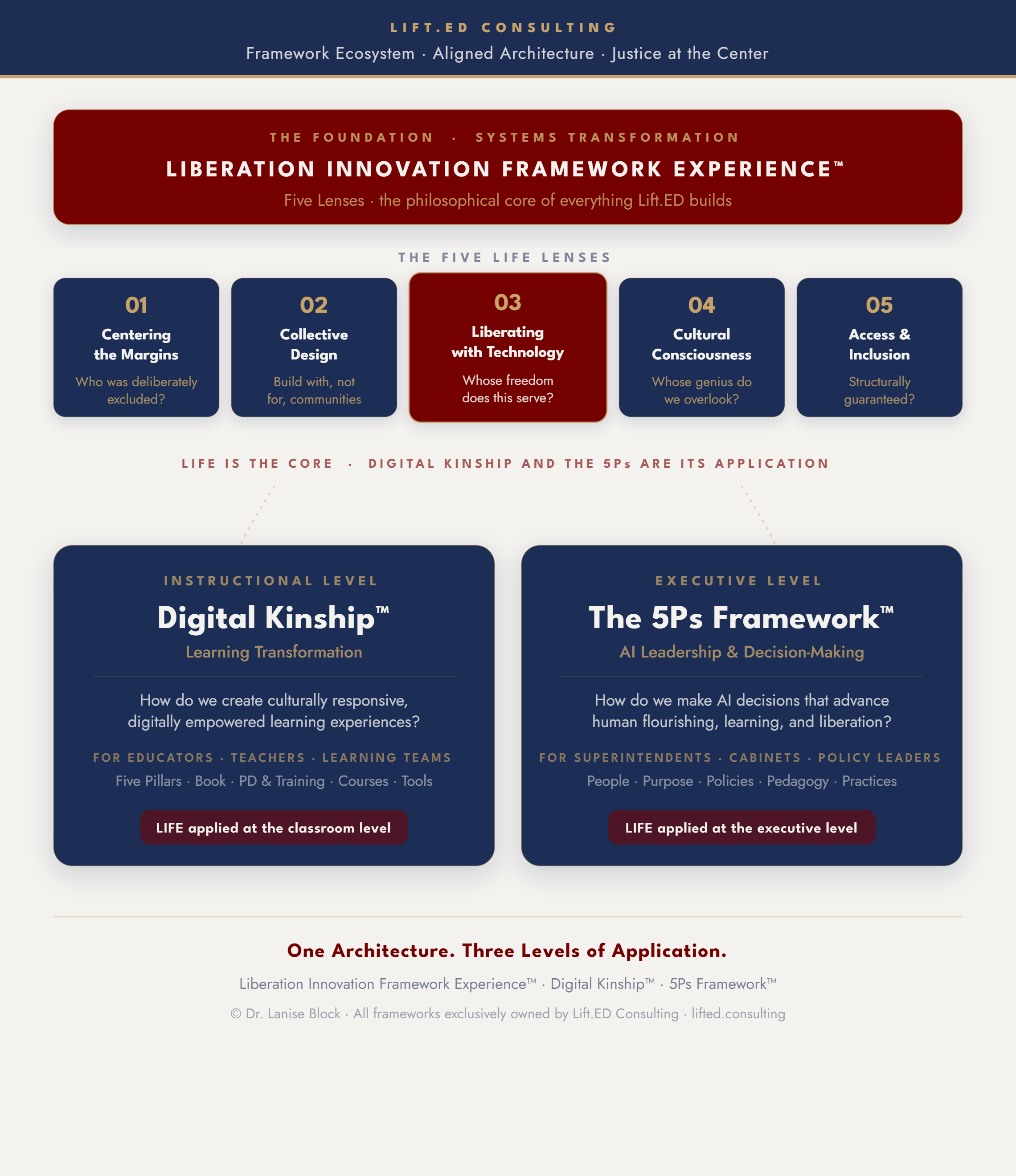
The Lift.ED approach is built on one foundational framework and two applications.
At the center is the Liberation Innovation Framework Experience™ (LIFE).
LIFE is the philosophical core.
It consists of five lenses that help leaders examine what their systems are actually doing before they begin changing them.
The goal is not simply innovation.
The goal is intentional transformation.
Transformation rooted in purpose, equity, and human agency.
From that foundation emerge two applications.
Digital Kinship™
Digital Kinship applies LIFE at the instructional level.
It helps educators design culturally responsive and digitally empowered learning experiences.
Instead of asking, "How can I use more technology?" educators begin asking better questions:
How does this technology strengthen relationships?
How does it honor student identity?
How does it expand opportunity and voice?
Technology becomes a tool for connection rather than compliance.
The 5Ps Framework for Purposeful AI Integration™
The second application is designed for executive leadership.
The 5Ps Framework applies LIFE to AI decision-making through five interconnected domains:
Purpose. Policies. Pedagogy. Practices. People.
While many organizations focus on AI implementation, the 5Ps Framework focuses on AI governance and leadership.
It helps cabinet-level leaders move beyond questions like: "What AI tool should we buy?"
And toward questions such as:
"What values should guide our decisions?"
"What safeguards must exist before implementation?"
"How will this impact trust, equity, and human agency?"
"What problem are we actually trying to solve?"
Those are leadership questions. Not technology questions.
Why This Matters in 2026
The challenge facing leaders today is not access to AI. The challenge is making sense of AI.
Most organizations are overwhelmed by options, conflicting advice, and pressure to move quickly.
Speed has become the dominant value. But speed without reflection often leads to unintended consequences.
The leaders who will navigate this moment successfully will not be those who adopt AI the fastest.
They will be those who adopt it most intentionally. The ones who understand that technology decisions are ultimately human decisions.
The ones who recognize that every AI policy, every implementation strategy, and every procurement decision reflects a set of values.
The ones willing to ask harder questions before chasing easier answers.
Three Frameworks. One Architecture.
The Lift.ED approach is not a collection of disconnected ideas.
It is a coherent leadership architecture.
Liberation Innovation Framework Experience™ (LIFE) helps leaders understand systems.
Digital Kinship™ helps educators transform learning experiences.
The 5Ps Framework for Purposeful AI Integration™ helps executive leaders govern AI responsibly.
Three frameworks.
One architecture.
Built for justice at every level of a system.
Because the future of AI will not be determined by technology alone.
It will be determined by the leaders who choose how that technology is used.
And that is a leadership challenge worth solving.